
Are Textbooks Really a Bad Buy?
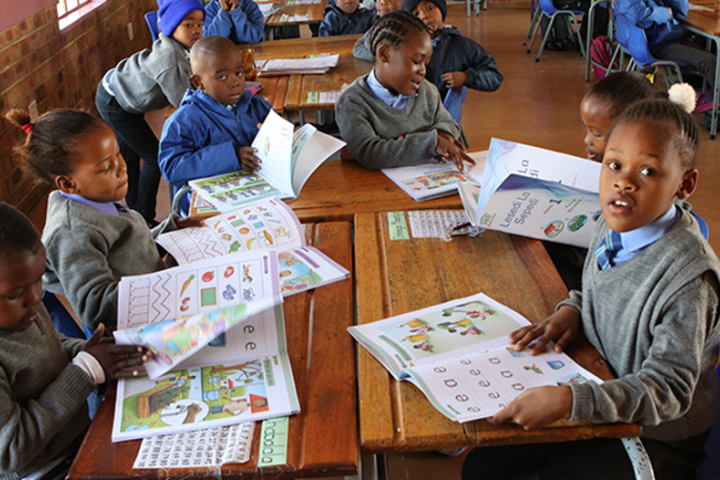
Students at Baxoxele Primary School in South Africa. (Photo credit: Room to Read)
Source link: https://tinyurl.com/3pc9xr4p
In its 2023 report, the Global Education Evidence Advisory Panel (GEEAP) classified textbooks as a “bad buy” for improving learning outcomes - one of several inputs that have repeatedly failed to raise achievement “when other issues are not addressed.” Textbooks were grouped with computers, school buildings, class size reductions, and teacher salaries as examples of additional resources that are not effective or cost-effective on their own.
It’s a careful qualification, but the nuance is lost in the report’s headline message. The broad takeaway - that investing in textbooks is not a good idea - has been widely interpreted as a general indictment of such inputs. This is misleading, with the evidence underpinning this claim far thinner are more context-specific than the summary implies. In fact, new research from Africa and beyond suggests that access to appropriate, high-quality text can itself drive substantial learning gains, particularly in early reading.
Lumping Unequal Things Together
By grouping textbooks with items as diverse as teacher salaries, laptops, and infrastructure, the GEEAP report creates the illusion of a substantial and consistent evidence base against inputs. Yet these are not comparable interventions. Each involves different mechanisms, costs, and implementation challenges. Aggregating them under one label risks misrepresenting the evidence base and undermines the nuance that responsible synthesis requires.
Declaring that “inputs alone” do not work may sound reasonable, but when “alone” encompasses everything from a book to a building, the conclusion becomes so broad as to be meaningless. What matters is not whether inputs are alone, but whether they are appropriate, used, and usable.
Two Studies, Two Contexts, Many Misreadings
The GEEAP’s classification of textbooks as a “bad buy” appears to rest primarily on two rigorous studies:
• Glewwe, Kremer, and Moulin (2009) in Kenya, and
• Sabarwal, Evans, and Marshak (2014) in Sierra Leone.
Both are careful, well-documented pieces of research. And both explicitly explain why the provision of books did not raise average learning outcomes, explanations that have been largely ignored in the GEEAP’s synthesis.
In Kenya, official government textbooks were written in English and pitched at a level far above most pupils’ comprehension. The top 40% of learners benefited. In Sierra Leone, schools received the books, but many headteachers stored them rather than distributing them, fearing that the supply might not continue.
Neither case shows that textbooks are ineffective in principle. Instead, both highlight the challenges of implementation, of ensuring that the right materials reach the right learners in a form they can use. These are failures of design and system incentives, not of textbooks as a pedagogical tool.
When Books Work
Evidence from other countries tells a different story. An RCT in Mongolia (Fuje and Tandon, 2018) found that providing classroom libraries alone substantially improved reading scores. In the Democratic Republic of Congo, Falisse et al. (2020) showed that small incentives to encourage the actual use of textbooks led to significant learning gains. An RCT in Liberia (Menendez, Hoadley, and Solovyeva 2025) found large gains in reading from a structured pedagogy program with teacher training, coaching, and teaching and learning materials. However, implementation data, surveys, and classroom observations show these gains were driven by students’ access to and use of high-quality reading materials, and not by improved teaching practices.
The common lesson is not that books fail but that books must be accessible, appropriate, and used.
Books Are a Necessary (If Not Sufficient) Condition
A growing body of research points to the centrality of learning materials in literacy development. Reviews of successful early grade reading programmes across low- and middle-income countries repeatedly identify one consistent feature: learners have access to appropriate reading materials, often at a one-to-one ratio (Graham & Kelly, 2018; Stern et al., 2021; Evans & Acosta, 2021).
Importantly, books do not only matter in class—they extend learning beyond it. When children can take textbooks and readers home, they gain direct access to the written “code” of schooling, which they can explore independently or with the support of parents, siblings, or other caregivers. This enables them to practise and revisit literacy skills beyond the limits of class time or teacher availability. In this sense, books are not just classroom aids; they are one of the few affordable tools that expand learning time and allow non-school others to mediate schooling.
Books alone may not guarantee learning. But learning to read without books is nearly impossible.
The Power and Risk of Declaring a “Bad Buy”
As GEEAP panellist, Tahir Andrabi, remarked in a 2024 VoxDev Talk (14 August 2024), “The role of research is not just saying what works, sometimes it is better to say what does not work. Killing the bad ideas.” There is value in this: eliminating ineffective practices is part of evidence-informed policymaking.
Yet calling something a “bad buy” carries powerful policy consequences. It shapes funding priorities and policy choices. Declaring textbooks a bad buy on the basis of two highly specific studies, each with documented implementation issues, while overlooking newer evidence that books alone can raise achievement, risks discouraging investment in one of the most basic and necessary ingredients of learning.
Responsible Evidence Aggregation Requires Nuance
The GEEAP report itself concedes, later in the text, that “good materials, including appropriate-level textbooks and instruction at the right level, provided alongside pedagogical improvements, can make a big difference.”
That recognition is key. The problem lies not with textbooks, but with whether they are appropriate and used, and with how the evidence has been summarised. Simplifying nuanced research into a binary of “good” and “bad” buys might make for powerful messaging, but it risks misinforming decision-makers who depend on these summaries to allocate scarce education budgets.
If the goal of evidence synthesis is to guide policy responsibly, then caution is warranted, especially when “killing bad ideas” risks discouraging essential investments in the most basic enabler of learning: access to books.
References
Evans, D. K. and Acosta, A. M. (2021). Education in Africa: What Are We Learning? Journal of African Economies. 30(1), 13–54.
Falisse, J.B., Huysentruyt, M. and Olofsgård, A. (2020). Incentivizing Textbooks for Self-Study: Experimental Evidence from the Democratic Republic of Congo. Academy of Management Proceedings 1, 19578.
Fuje H. and Tandon, P. (2018). When do in-service teacher training and books improve student achievement? Experimental evidence from Mongolia. Review of Development Economics. 22(3), 1360–1383.
Glewwe, P., Kremer, M. and Moulin, S. (2009). Many Children Left Behind? Textbooks and Test Scores in Kenya. American Economic Journal: Applied Economics, 1(1), 112–135.
Graham, J. and Kelly, S. (2018). How Effective are Early Grade Reading Interventions? A Review of the Evidence (English). Policy Research Working Paper, no. WPS 8292 Washington, D.C.: World Bank Group.
Menendez, A. Hoadley, U., and Solovyeva, A. (forthcoming). Understanding Improvements in Reading Performance in Liberia: Investigating the Centrality of Text. Economic Development and Cultural Change.
Sabarwal, S., Evans, D. K. and Marshak, A. (2014). The Permanent Input Hypothesis: The Case of Textbooks and (No) Student Learning in Sierra Leone. Policy Research Working Paper: No. 7021. World Bank Group, Washington, DC.
Stern, J., Jukes, M., Piper, B., DeStefano, J., Mejia, J., Dubeck, P., Carrol, B., Jordan, R Gatuyu, C., Nduku, T., Punjabi, M., Harris Van Keuren, C. and Tufail, F. (2021). Learning at Scale: Interim Report. RTI International.